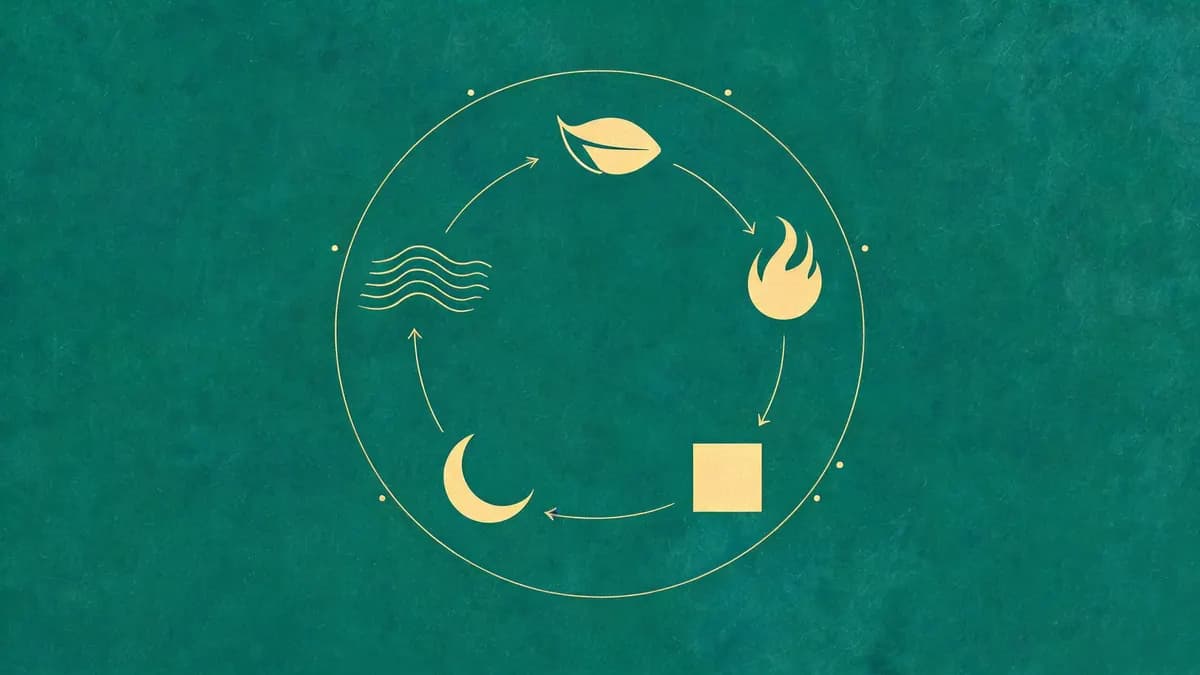
Every Bazi chart is, at its core, a map of five forces — Wood (木), Fire (火), Earth (土), Metal (金), and Water (水). Together they are called the Wu Xing (五行), and they are the language Bazi uses to describe personality, relationships, career, and timing. Before you can read a single pillar, you need to understand what these five elements do — and how they interact.
Think of the elements not as literal substances but as patterns of energy. Wood is growth and expansion. Fire is passion and visibility. Earth is stability and nurturing. Metal is precision and discipline. Water is wisdom and adaptability. Every character in your chart carries one of these five signatures, and the way they combine tells your story.
The Five Elements and What They Represent
Each element maps to a cluster of traits. When an element is strong in your chart, those traits tend to be prominent in your personality:
| Element | Energy | Core Traits |
|---|---|---|
| Wood (木) | Growth | Vision, initiative, creativity, the drive to expand |
| Fire (火) | Passion | Charisma, expression, warmth, the need to be seen |
| Earth (土) | Stability | Reliability, nurturing, patience, the grounding force |
| Metal (金) | Precision | Discipline, clarity, justice, the cutting edge |
| Water (水) | Wisdom | Adaptability, depth, intuition, the flow of intelligence |
The Generating Cycle (相生)
The five elements feed each other in a continuous circle called the generating cycle (相生). Each element nourishes the next, creating a flow of energy that moves around the wheel:
- Wood generates Fire — creativity fuels passion. Your vision and ideas become the fuel that ignites your drive to be seen and express yourself.
- Fire generates Earth — passion leaves a residue of stability. The warmth and intensity of Fire settles into the grounded reliability of Earth.
- Earth generates Metal — compression creates precision. The density and pressure of Earth crystallizes into the sharp clarity of Metal.
- Metal generates Water — structure condenses into flow. The rigidity of Metal melts and becomes the adaptive fluidity of Water.
- Water generates Wood — wisdom nourishes growth. The deep resources of Water feed the upward expansion of Wood, completing the cycle.
The Controlling Cycle (相克)
The second cycle is the controlling cycle (相克). Each element restrains another, keeping the system in balance:
- Wood controls Earth — roots break up soil. Growth and expansion can disrupt stability and established structures.
- Earth controls Water — dams contain rivers. Stability and boundaries keep adaptability from scattering.
- Water controls Fire — rain extinguishes flame. Depth and wisdom temper passion and impulsiveness.
- Fire controls Metal — heat melts blades. Passion and intensity soften rigid discipline.
- Metal controls Wood — axes fell trees. Precision and structure prune unchecked growth.
What Your Element Balance Reveals
Your chart's element balance — how much of each of the five elements you have — is one of the most practical things Bazi reveals. Most people have a dominant element or two and a weak or missing element. This isn't good or bad — it simply describes your natural tendencies and potential blind spots.
If you have abundant Wood, you're likely a natural initiator — someone who starts projects, sees possibilities, and pushes forward. If Wood is weak, you might admire visionaries but struggle to generate momentum on your own. Neither is superior; the question is how you work with your natural energy.
A chart with strong Earth tends toward loyalty, patience, and building things that last. A chart dominant in Fire gravitates toward visibility, performance, and emotional connection. Metal-heavy charts value order, principle, and getting things exactly right. Water-dominant charts are intuitive, strategic, and comfortable with complexity.
Reading Your Own Element Mix
To see your personal element distribution, you need your actual chart. Our calculator generates your Four Pillars, then tallies the five elements across all eight characters — including the hidden stems inside each Earthly Branch — and shows you the exact percentage of each.
When you look at your element balance, ask yourself three questions: Which element is strongest? That's your dominant energy. Which is weakest or missing? That's your growth edge. Do the strong elements generate or control each other? A chart where strong elements feed each other (generating cycle) tends to feel effortless; one where they clash (controlling cycle) creates internal tension that drives growth.
The Elements and Your Day Master
Your Day Master — the Heavenly Stem at the top of your Day Pillar — has its own element, and that element is your core identity. Everything else in your chart is read relative to it. The other elements in your chart either support your Day Master (through the generating cycle) or challenge it (through the controlling cycle).
This is why two people can have similar element distributions but very different experiences — the same mix of elements plays out differently depending on which one is your Day Master. A person whose Day Master is Wood reads abundant Water as nourishing support; a person whose Day Master is Fire reads the same abundant Water as something that dampens their flame.
Putting It All Together
The Five Elements are the grammar of Bazi. Once you can recognize the elements and their two cycles — generating and controlling — you can start to read the relationships in any chart. You'll see why certain periods of your life felt expansive (generating energy) and others felt like constant friction (controlling energy). And you'll understand that neither is inherently good or bad: both cycles are necessary for a chart — and a life — to function.
Ready to see your own Five Elements balance?
Calculate my free chart